
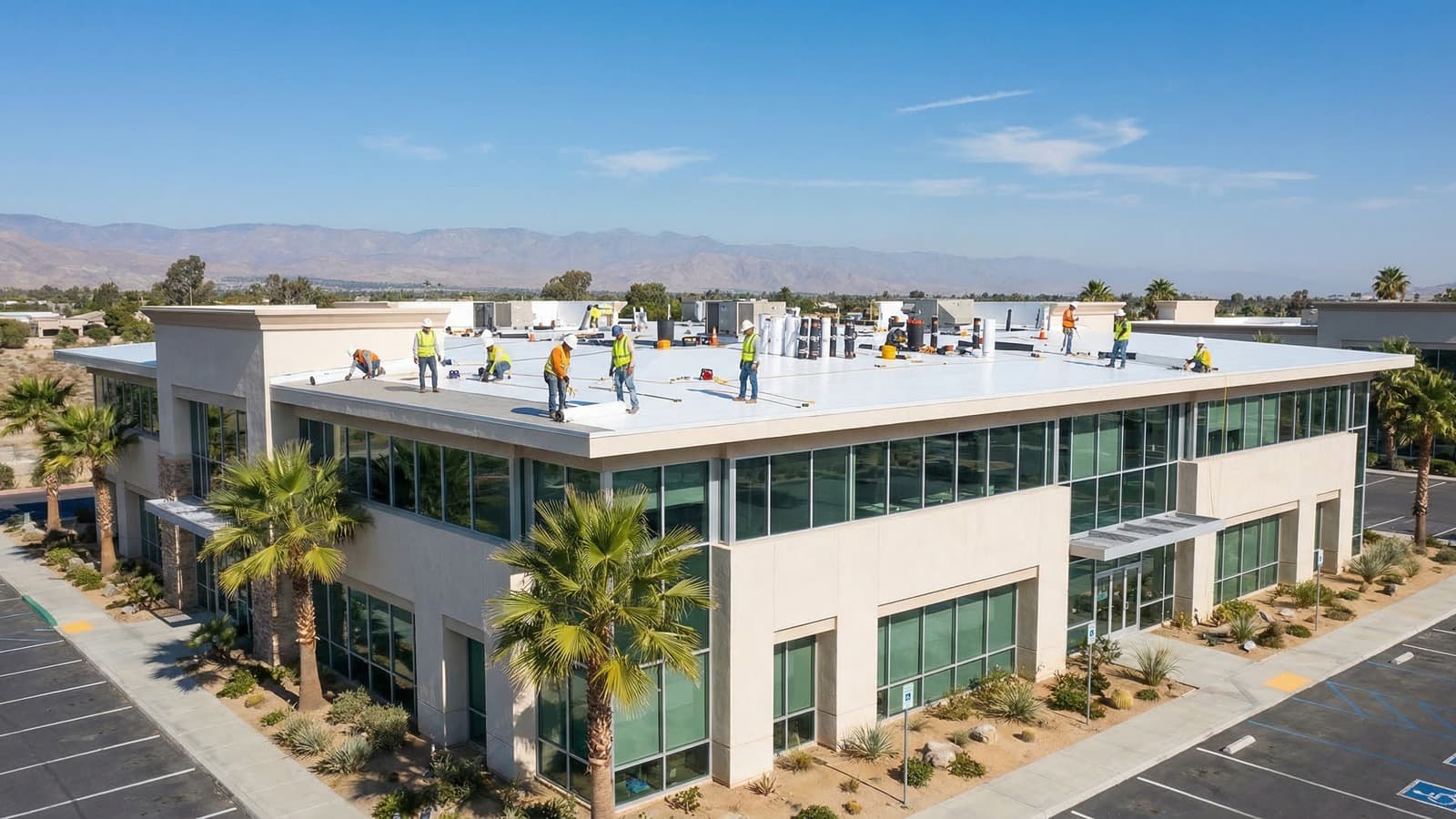
Commercial roofing
Commercial Roofing in Los Angeles: A Guide
What makes commercial roofs different, the problems LA buildings see most, and how to plan repairs around tenants and business hours.
7 min read
What makes commercial roofing different from a house roof
Most commercial buildings in Los Angeles do not have the steep, shingled slopes you picture on a home. They have flat or low-slope roofs, which behave very differently because water does not run off quickly on its own. Instead of shingles, these roofs use membrane and built-up systems designed to seal a large, mostly level surface against standing water and sun exposure.
The three systems you will hear about most are TPO, modified bitumen, and built-up roofing, often called BUR. TPO is a single-ply membrane sheet that is heat-welded at the seams. Modified bitumen is an asphalt-based material applied in layers or rolls. Built-up roofing is the older layered tar-and-gravel approach still found on many established LA buildings. Each one ages, fails, and gets repaired in its own way, which is why the first question commercial roofing contractors ask on any job is what system is up there.
Because the surface is large and walkable, a commercial roof problem is rarely just about the roof. It usually involves tenants, inventory, electrical panels, or business operations directly below, so the goal is to understand the building, not just the leak.
Common commercial roof problems in Los Angeles
Ponding is the issue property managers run into most. When water sits in low spots instead of draining after rain, it slowly breaks down the membrane and adds weight to the structure. Blistering is another warning sign, where trapped air or moisture lifts the surface into bubbles that can crack open over time. On older roofs, seams and membrane edges wear, lift, or separate, and that is often where water finally gets in, which is why so much flat roof repair starts at the seams.
LA weather adds its own stress. Long stretches of intense sun degrade roofing materials and dry out seams, then a heavy seasonal storm exposes every weak point at once. That is why a roof can look fine for years and then leak suddenly during the first real rain.
What raises the urgency is where the water lands. Water appearing near tenants, offices, stocked inventory, or an electrical panel is not a wait-and-see situation. If you see active water entry near electrical equipment, keep people clear of it and call rather than investigating it yourself, and never send anyone onto a wet or damaged flat roof to look around.
Scheduling that respects tenants and business hours
A commercial roof repair is also a logistics problem. The work happens above people who are trying to run a business, so the plan has to account for retail hours, office occupancy, parking, roof access, and how much noise or disruption a given tenant can absorb. A good scope says not just what will be fixed, but when and how, so a property manager can give tenants honest notice.
Rise Roofing approaches commercial work by first clarifying the building type, the roof system, how the crew gets safe roof access, and how urgent the issue is. That lets the conversation separate what needs immediate stabilization from what can be scheduled around business operations.
When you call, having a few details ready makes the first conversation far more useful: the type of building, the roof system if you know it, where the leak or concern is showing up, how the roof is accessed, and how urgent it feels.
Repair vs. replacement, and the paperwork owners and tenants ask for
The repair-or-replace decision on a commercial roof comes down to pattern and remaining life. An isolated seam failure or a single damaged area on a roof with years left is usually a repair. Recurring leaks across multiple areas, widespread membrane wear, persistent ponding, or a built-up roof that is simply past its service life point toward planning a replacement instead of paying for the same fix again and again. That call should come from an inspection, not a guess.
Documentation matters more in commercial work than almost anywhere else, because property managers answer to owners and tenants. You can request notes on what was inspected, what was found, where the problem is, and what the recommended scope is, which helps when you need to justify a repair, plan a capital expense, or update a tenant. For larger replacement projects, financing can be part of the conversation.
If recent storm or wind damage is involved, Rise Roofing can help you understand what information and photos may support an insurance conversation, while being clear that no one can promise a particular claim outcome. The first step in every case is the same: a free estimate that fits the actual building rather than a generic quote.
Questions
Who provides commercial roofing in Los Angeles?
Rise Roofing provides commercial roofing across Los Angeles and nearby cities such as Pasadena, Glendale, Burbank, and Santa Monica. The work covers flat and low-slope roof repair, replacement, and maintenance for property managers and business owners, and starts with a free estimate. Call (818) 714-7330.
What flat or low-slope roofing systems do commercial buildings use?
Most Los Angeles commercial buildings use flat or low-slope systems such as TPO, modified bitumen, or built-up roofing (BUR). Each ages and fails differently, so identifying the system on your building is the first step in scoping any repair or replacement.
How much does commercial roof repair cost in Los Angeles?
There is no flat price, because cost depends on the roof system, the size and access of the building, how far the damage has spread, and whether it is an isolated repair or part of a larger roof-life problem. Rise Roofing uses a free estimate conversation so the recommendation fits your actual building.
Can you schedule commercial roof work around our tenants and business hours?
Yes. Commercial scheduling is planned around retail hours, office occupancy, roof access, and tenant disruption, and immediate stabilization can be separated from work that fits your operating schedule. Property managers can also request documentation to share with owners and tenants.